Operating SystemOS => Every computer system run on a base software called Operating System (OS). Operating System controls all basic operations of the computer (such as smartphone, PDAs, tablet computers and other handheld devices). The Operating System allows the user to install and run third party applications (apps), apps are used to add new functionality to the device.
Android 14, HyperOS (2 OS upgrades)
ChipsetChipset is a group of integrated circuits designed to perform one or a more dedicated functions, often with real time computing constraints, Popular smartphones are equipped with more advanced embedded chipsets that can do many different tasks depending on their programming.
GPUGPU (Graphics Processing Unit) is a single-chip processor designed to rapidly manipulate and alter memory to accelerate the creation of images in a frame buffer intended for output to a display, This includes things such as lighting effects, object transformations, and 3D motion.
Display TypeDisplay Technology => A number of display technologies and types used in mobile phones => TFT (Thin Film Transistor), IPS (In-Place Switching), OLED (Organic Light Emitting Diode), AMOLED (Active-Matrix Organic Light-Emitting Diode), Super AMOLED (an even advanced version of AMOLED), Resistive Touchscreen (Resistive touchscreens contain two layer of conductive material with a very small gap between them which acts as a resistance), Capacitive Touchsceen (Capacitive touchscreen technology consists of a layer of glass coated with a transparent conductor)
AMOLED
Size
6.67 inches (~395 ppi)
Resolution
1080 x 2400 px (FHD+)
Aspect Ratio
20:9
Refresh Rate
120Hz, up to 2100 nits (peak), 960Hz PWM, HDR10+, Dolby Vision (India)
Display ProtectionDisplay Protection => Gorilla Glass is a special alkali-aluminosilicate glass shield with exceptional damage resistance that helps protect mobile displays from scratches, drops, and bumps of everyday use, It is always better to go for a smartphone with Gorilla Glass for that added protection and peace of mind.
Gorilla Glass 5
Touch Screen
240Hz touch sampling, 87.4% screen-to-body
Connectivity
Network
2G, 3G, 4G, 5G (SA/NSA)
SIMSIM (Subscriber Identity Module) is a small card that contains mobile network subscriber's account information. This allows the phone using the card to attach to a mobile network. The SIM card is most commonly associated with GSM and UMTS mobile networks. Moving a SIM card from one phone to another allows a subscriber to switch mobile phones without having to contact their mobile network carrier. SIM cards can also be used by a phone to store limited amounts of data, such as phone numbers and text messages.
Standard SIM
WLAN
Wi-Fi 802.11 a/b/g/n/ac, dual-band
BluetoothBluetooth is a wireless communications technology for exchanging data between mobile phones, headsets, computers and other network devices over short distances without wires, Bluetooth technology was primarily designed to support simple wireless networking of personal consumer devices.
5.x, A2DP, LE
GPSGPS The Global Positioning System is a satellite-based radio navigation system, GPS permits users to determine their position, velocity and the time 24 hours a day, in all weather, anywhere in the world, In order to locate your position, your device or GPS receiver must have a clear view of the sky.
GPS, GLONASS, GALILEO, BDS
Radio
Yes (FM radio, region dependent)
USB
USB Type-C 2.0, OTG
Infrared port
Yes (IR blaster)
SOUND
3.5mm Jack
Loudspeaker
Yes, stereo speakers (Dolby Atmos)
Noise Cancel. Mic.
Recording
Extra Microphone
SECURITY
Fingerprint
Under display (optical)
Face Unlock
Battery
Battery TypeBattery Type => Cell phones run on various kinds of batteries depending on the manufacturer, phone size or shape and features. There are basically four types of cell phone batteries => Lithium Polymer, Lithium Ion, Nickel Metal Hydride and Nickel Cadmium.
Li-Ion (Lithium Ion)
CapacityBattery Capacity is a measure (typically in Amp-hr) of the charge stored by the battery, and is determined by the mass of active material contained in the battery. The battery capacity represents the maximum amount of energy that can be extracted from the battery under certain conditions.
5110 mAh
Charging
45W wired turbo
OTHERS
SensorsSensors are electronic components that detects and responds to some type of input from the physical environment. The specific input could be light, heat, motion, moisture, pressure and location, The output is generally a signal that is converted to use in computing systems, a location sensor, such as a GPS receiver is able to detect current location of your electronic device.
Fingerprint (under display), NFC, IR blaster, accelerometer, gyro, compass, proximity
Manufactured by
Xiaomi
Made in
China / India
Models
Xiaomi Poco M7 Pro 5G
Our Rating
The overall rating is based on review by our experts
7
Design7 / 10
Display8 / 10
Performance6 / 10
Camera7 / 10
Connectivity7 / 10
Features7 / 10
Battery7 / 10
Usability7 / 10
PROS
50MP f/1.5 Sony camera with OIS
6.67-inch 120Hz AMOLED (2100 nits, HDR10+)
5110mAh battery with 45W charging
3.5mm jack, IR blaster, and microSD slot
Stereo speakers with Dolby Atmos and 5G
CONS
Only a 2MP depth sensor, no ultrawide
Video capped at 1080p
Dimensity 7025 Ultra is mid-tier only
Plastic build with basic IP64 rating
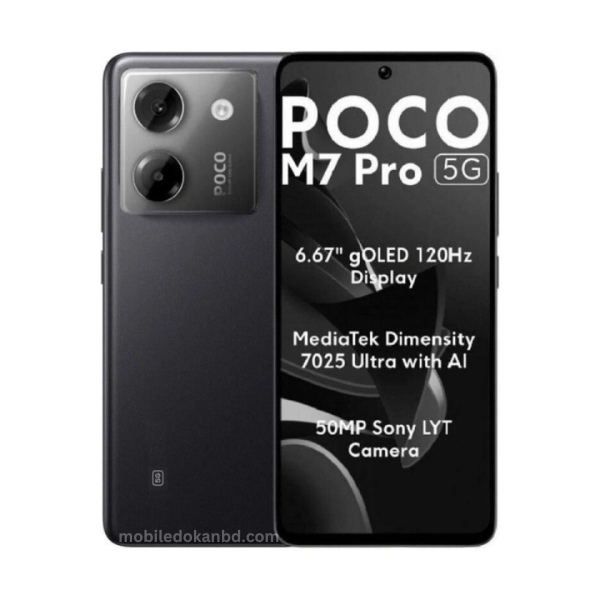
The Poco M7 Pro 5G is a mid-budget 5G phone, and the Poco M7 Pro 5G price in Bangladesh starts at around BDT 18,500 for the 6GB/128GB model. It pairs a 6.67-inch 120Hz AMOLED display with a 50MP f/1.5 Sony OIS camera. In addition, it offers a 5110mAh battery, 45W charging, a 3.5mm jack, and an IR blaster. However, it stays mid-tier, with a basic chip and 1080p-only video. Read the full specifications, the price in Bangladesh, and our review below.
The Poco M7 Pro 5G targets buyers who want a strong camera and a smooth AMOLED screen on a mid-budget. As a result, its main draws are a 50MP OIS camera, a 120Hz AMOLED display, and 5G. In addition, it keeps handy extras like a 3.5mm jack, an IR blaster, and a microSD slot. However, it stays mid-tier, with a modest chip and 1080p-only video. Overall, it is a well-rounded value 5G phone.
Design and Build
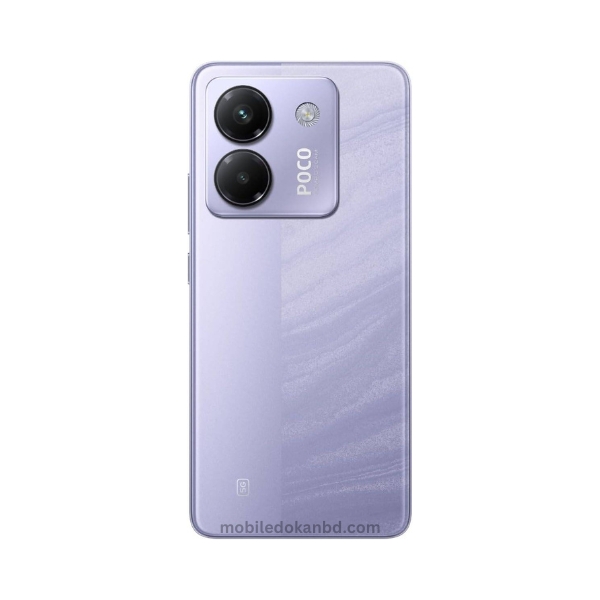
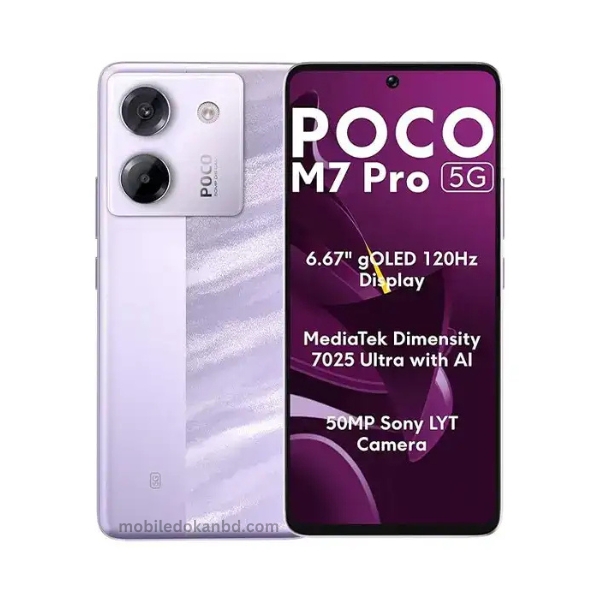
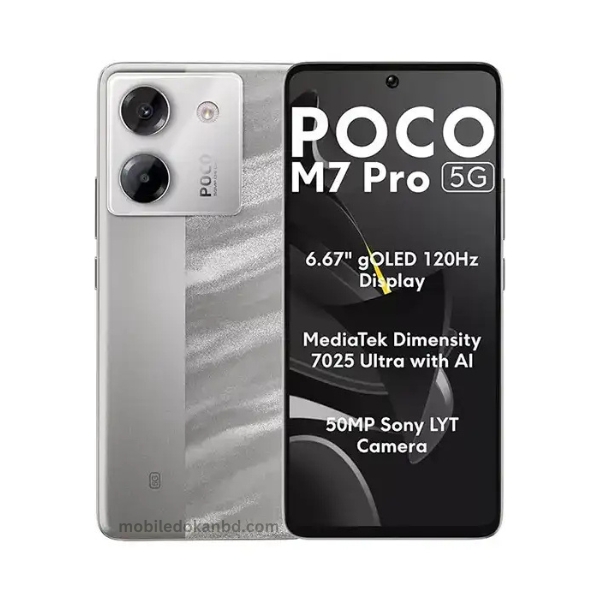
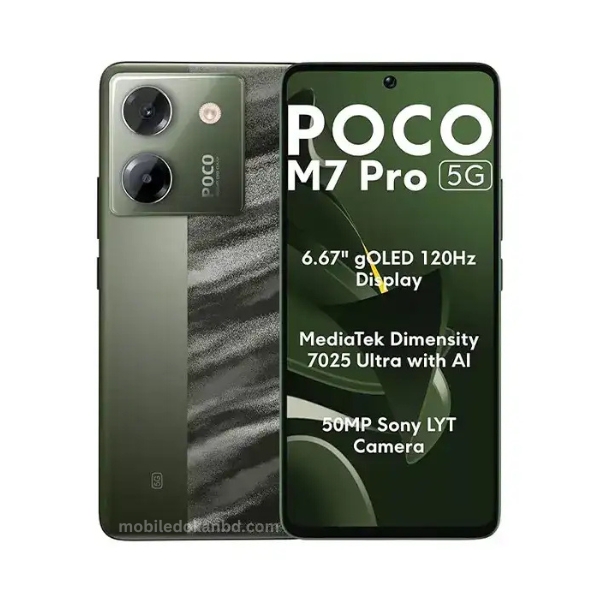
The Poco M7 Pro 5G has a slim, modern look. It measures 8 mm thick and weighs just 190 g, so it feels comfortable to hold. The build uses a Gorilla Glass 5 front with a plastic frame and a dual-tone plastic back. In addition, it carries an IP64 rating against dust and splashes. It comes in Lavender Frost, Olive Twilight, and Lunar Dust.
A 6.67-inch 120Hz AMOLED Display
The Poco M7 Pro 5G has a 6.67-inch FHD+ AMOLED display with a smooth 120Hz refresh rate. In addition, it reaches up to 2100 nits peak brightness and supports HDR10+, so it stays bright and vivid. Gorilla Glass 5 also adds scratch protection. As a result, the screen is a real highlight for the price, whether you are watching video or scrolling social media.
Performance and Dimensity 7025 Ultra
The Poco M7 Pro 5G runs on the 6nm Dimensity 7025 Ultra chip with up to 12GB of RAM. Under Android 14 with HyperOS, it handles daily apps, multitasking, and light gaming smoothly. In addition, 5G keeps downloads and streaming fast. However, this is a mid-tier chip, so it is not built for the heaviest games. For a newer Poco option, see the Poco M8s.
50MP OIS Camera
The camera is a strong point. The Poco M7 Pro 5G has a 50MP main camera built around a Sony sensor with a bright f/1.5 aperture and OIS, so photos stay sharp and steady, even in low light. Alongside it sits a 2MP depth sensor for portraits. In good light, the main camera takes detailed, vibrant photos. However, there is no ultrawide lens, and video is capped at 1080p. Up front, a 20MP selfie camera handles video calls.
5110mAh Battery and 45W Charging
The Poco M7 Pro 5G packs a 5110mAh battery. As a result, it comfortably lasts a full day of normal use. When it runs low, 45W fast charging refills it quickly. In addition, the battery is TÜV certified for long-term health. So it stays reliable over years of use, which is reassuring at this price.
Software, Connectivity, and Security
The Poco M7 Pro 5G ships with HyperOS, based on Android 14, with two major OS upgrades. For connections, it is well equipped: you get 5G, dual SIM, NFC, an IR blaster, and Wi-Fi. It also keeps a 3.5mm headphone jack, FM radio, a microSD slot, and stereo speakers with Dolby Atmos. An under-display fingerprint sensor and face unlock handle security. For full details, see the official Poco M7 Pro 5G product page or the official specifications page.
Poco M7 Pro 5G Price in Bangladesh with Variants
The Poco M7 Pro 5G price in Bangladesh is around BDT 18,000 for the 6GB/128GB model, rising to about BDT 22,999 for the 8GB/256GB version. Imported (unofficial) units are a little lower. Prices vary by shop and between official and import units. Here is the current price list:
Variant (RAM / Storage)
Official Price
6GB / 128GB
৳ 18,500
8GB / 256GB
৳ 20,999
Poco M7 Pro 5G price in Bangladesh. Official and unofficial (import) prices vary by shop.
At this price, the Samsung Galaxy A16 5G is a close rival. The A16 5G counters with longer Samsung software support and a triple camera. However, the Poco M7 Pro 5G answers with a brighter 120Hz AMOLED, a stronger 50MP OIS camera, and faster 45W charging. So your choice comes down to priorities. Pick the A16 5G for updates, or the Poco for the screen and camera.
Should You Buy the Poco M7 Pro 5G?
The Poco M7 Pro 5G makes sense if you want a great screen, a strong main camera, and 5G on a mid-budget. You also get a headphone jack, an IR blaster, and microSD support. However, the trade-offs are real. For example, the chip is only mid-tier, there is no ultrawide, and video tops out at 1080p. If you want a newer option, the Poco M8s is worth a look. Overall, though, the Poco M7 Pro 5G is a solid value 5G phone.
Poco M7 Pro 5G FAQs
1. What is the Poco M7 Pro 5G price in Bangladesh?
The Poco M7 Pro 5G price in Bangladesh is around BDT 18,500 for the 6GB/128GB model, and up to about BDT 20,999 for the 8GB/256GB version. Imported (unofficial) units are a little lower.
2. When was the Poco M7 Pro 5G released?
The Poco M7 Pro 5G was released on 20 December 2024. It is available in the Bangladesh market through import channels.
3. Does the Poco M7 Pro 5G support 5G?
Yes. The Poco M7 Pro 5G supports 5G, along with 2G, 3G, and 4G networks. It also supports dual SIM, NFC, and Wi-Fi.
4. What chipset and RAM does the Poco M7 Pro 5G have?
It uses the 6nm MediaTek Dimensity 7025 Ultra chipset with the IMG BXM-8-256 GPU. You can also choose 6GB, 8GB, or 12GB of RAM, with RAM extension support.
5. What kind of display does the Poco M7 Pro 5G have?
It has a 6.67-inch FHD+ AMOLED display. The screen runs at 120Hz, reaches up to 2100 nits, and supports HDR10+ for bright, vivid visuals.
6. What cameras does the Poco M7 Pro 5G have?
The back has a 50MP main camera with OIS and a 2MP depth sensor. The front has a 20MP selfie camera. Both record 1080p video at 30fps.
7. How big is the battery and how fast does it charge?
The Poco M7 Pro 5G has a 5110mAh battery with 45W fast charging. As a result, it comfortably lasts a full day. The battery is also TUV certified for long-term health.
Poco M7 Pro 5G Rating Explained — How We Scored It
We rate every phone across eight areas on a 1–10 scale. Our scores come from real-world use and reviews. We then average them for the overall result. As a result, the Poco M7 Pro 5G earns an overall 7/10. Here is how each area scored, and why.
Design – 7/10
The slim 190g body, dual-tone finish, and Gorilla Glass 5 front look and feel good for the price. The IP64 rating adds light splash protection. However, the plastic frame and back keep it in budget territory.
Display – 8/10
The 6.67-inch FHD+ AMOLED runs at 120Hz and hits up to 2100 nits with HDR10+ support. As a result, it is bright, smooth, and vivid, which is excellent at this price. Only the 8-bit colour depth is a minor limit.
Performance – 6/10
The Dimensity 7025 Ultra is a capable 6nm mid-tier chip. It handles daily tasks, multitasking, and light gaming well. However, it is not built for the heaviest titles, so demanding games need lowered settings.
Camera – 7/10
The 50MP f/1.5 Sony main camera with OIS is a real strength, taking sharp, steady photos even in low light. However, the second sensor is only a 2MP depth unit, there is no ultrawide, and video is capped at 1080p.
Connectivity – 7/10
You get 5G, dual SIM, NFC, an IR blaster, Wi-Fi, and a 3.5mm jack, which is a strong set for the price. FM radio and USB-C round it out. Only the older Wi-Fi standard is a small limit.
Features – 7/10
A headphone jack, IR blaster, microSD slot, stereo speakers with Dolby Atmos, and a TUV-certified battery are all welcome. However, the basic IP64 rating and Gorilla Glass 5 keep the score moderate.
Battery – 7/10
The 5110mAh battery comfortably lasts a full day of normal use, and 45W charging tops it up quickly. The TUV long-cycle certification is a nice bonus. The capacity is solid rather than class-leading.
Usability – 7/10
The bright AMOLED, strong main camera, headphone jack, microSD, and fast charging make it practical for daily use. The mid-tier chip, 1080p video cap, and missing ultrawide are the main limits.
In short, the Poco M7 Pro 5G is a well-rounded mid-budget 5G phone with a bright AMOLED screen, a strong 50MP OIS camera, and handy extras like a headphone jack and IR blaster. The main compromises are the mid-tier chip and the 1080p video cap. However, for everyday users who want value and 5G, it is a smart choice.
We only inform you where you can find this product; please verify all details before purchase. Prices may vary by shop and between official and unofficial units. Click here for Xiaomi all phone price in Bangladesh or visit Mobile Dokan BD for more smartphone prices and reviews.
we can't guarantee that all the specifications are 100% accurate. Although most of this information was taken directly from the brand's official websites and other verified sources, there is still a chance that some mistakes could have occurred with manual data entry or other factors.